Light version
MCF Technology plant catalogue
One photo and one short description per processing line, with no charts or interactive tools: a low-data page for slow or metered connections. Open the full sheet of each line for technical data, line modules and PDF datasheets. Delivery, installation and on-site service worldwide.
Download the PDF catalogue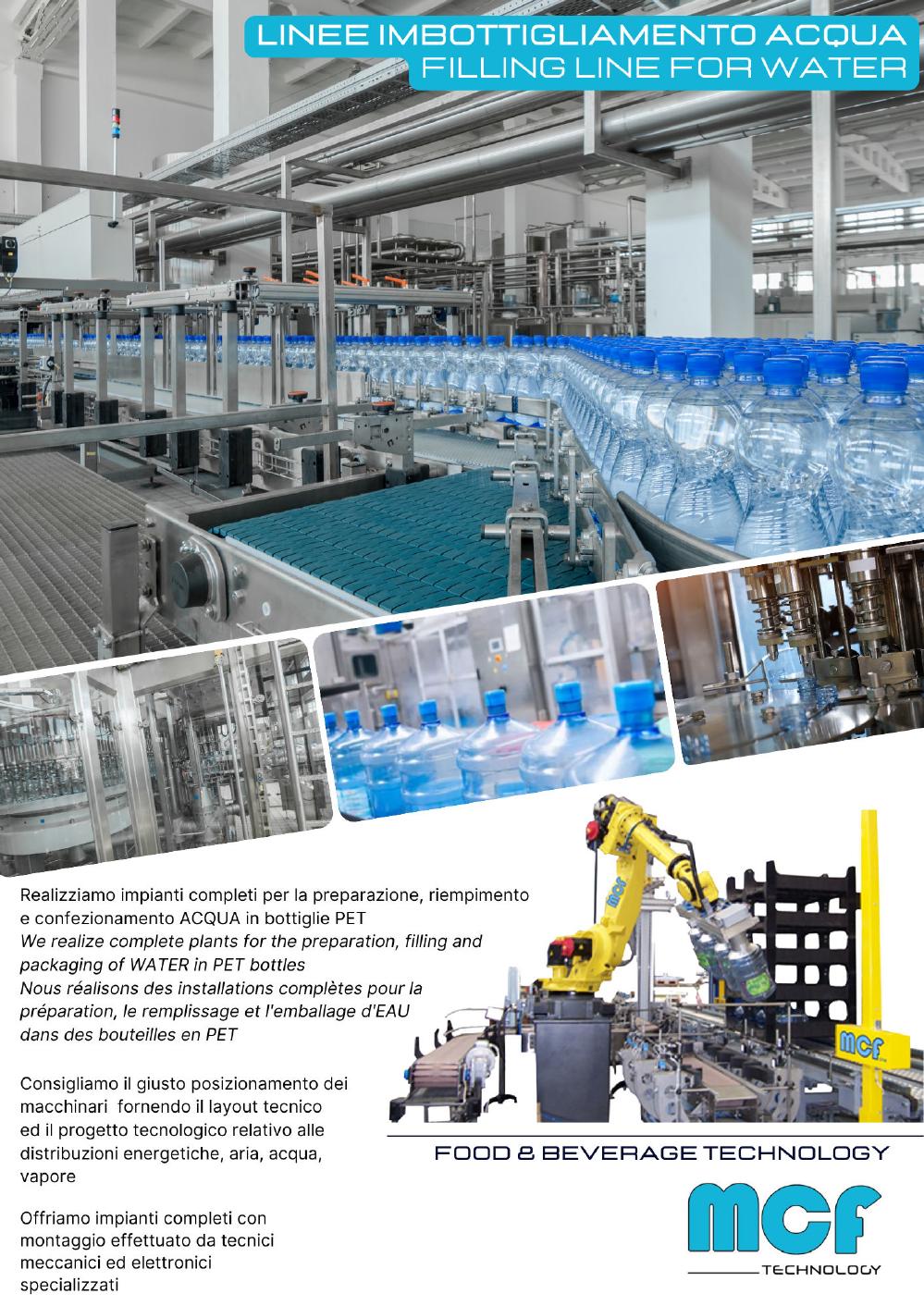
Water bottling line — turnkey PET filling plant
Complete still and mineral water bottling plant: treatment, PET blowing, rinsing, filling, capping, labelling and packaging supplied and commissioned by one team.
Finished products: Bottiglie PET.
Full sheet and technical dataHow to install and operate the water bottling line — turnkey filling plant: step-by-step procedure (about 33 working days)
The operating sequence MCF Technology follows to install, commission and start up the water bottling line — turnkey filling plant, through to daily operation and planned maintenance. Delivery, erection and on-site service are included worldwide.
- 1. Site survey and utilities check (2 days): Technical survey on the layout of the water bottling line — turnkey filling plant: passage heights, flooring and drains, maintenance clearances and availability of analysed raw water, a dedicated drain and filtered compressed air for the blow moulder. The final list of customer-side preparations is handed over.
- 2. Shipment, receiving and positioning of the modules (3 days): Worldwide delivery with sea-freight or road packing, unloading and positioning of the modules (Trattamento acqua e serbatoi di accumulo, Soffiaggio PET o depallettizzatore bottiglie, Blocco risciacquo–riempimento–tappatura) on the areas foreseen by the layout, checking the packing list and the condition of the components.
- 3. Mechanical assembly and piping (12 days): Assembly of the units, conveyor alignment, hygienic welding of the stainless-steel piping and installation of valves and instruments according to the P&ID, supervised on site by MCF Technology technicians.
- 4. Utility hook-ups and electrical connections (4 days): Connection of analysed raw water, a dedicated drain and filtered compressed air for the blow moulder, wiring of the electrical cabinet and PLC, earthing, HMI configuration and process recipes for the planned formats (Bottiglie PET).
- 5. Sanitation, CIP and dry runs (3 days): Washing and passivation of the product-contact surfaces, CIP circuit verification with flow, temperature and detergent-concentration control, tightness tests and dry-run cycles on all modules.
- 6. Functional commissioning and process trials (4 days): circuit tightness and sanitation test, verification of the water treatment parameters and empty-bottle filling test on the declared bottle formats. Trials are run with the customer's real product and recorded in the commissioning report.
- 7. Production start-up and staff training (5 days): Assisted start-up with continuous production, training of operators and maintenance staff on HMI, format changeover, safety and sanitation, handover of manuals and drawings in the agreed language.
- 8. Daily operation and planned maintenance: Daily operation with water-treatment conductivity, fill level and capping torque checks. Planned maintenance: replacement of treatment cartridges and membranes, UV lamp check and filling-valve gasket inspection. On-site and remote service with critical spare parts agreed in the quotation.
Durations and activities are indicative: the erection, commissioning and training plan is defined in the quotation after the site survey and line sizing. No figure is a contractual performance.
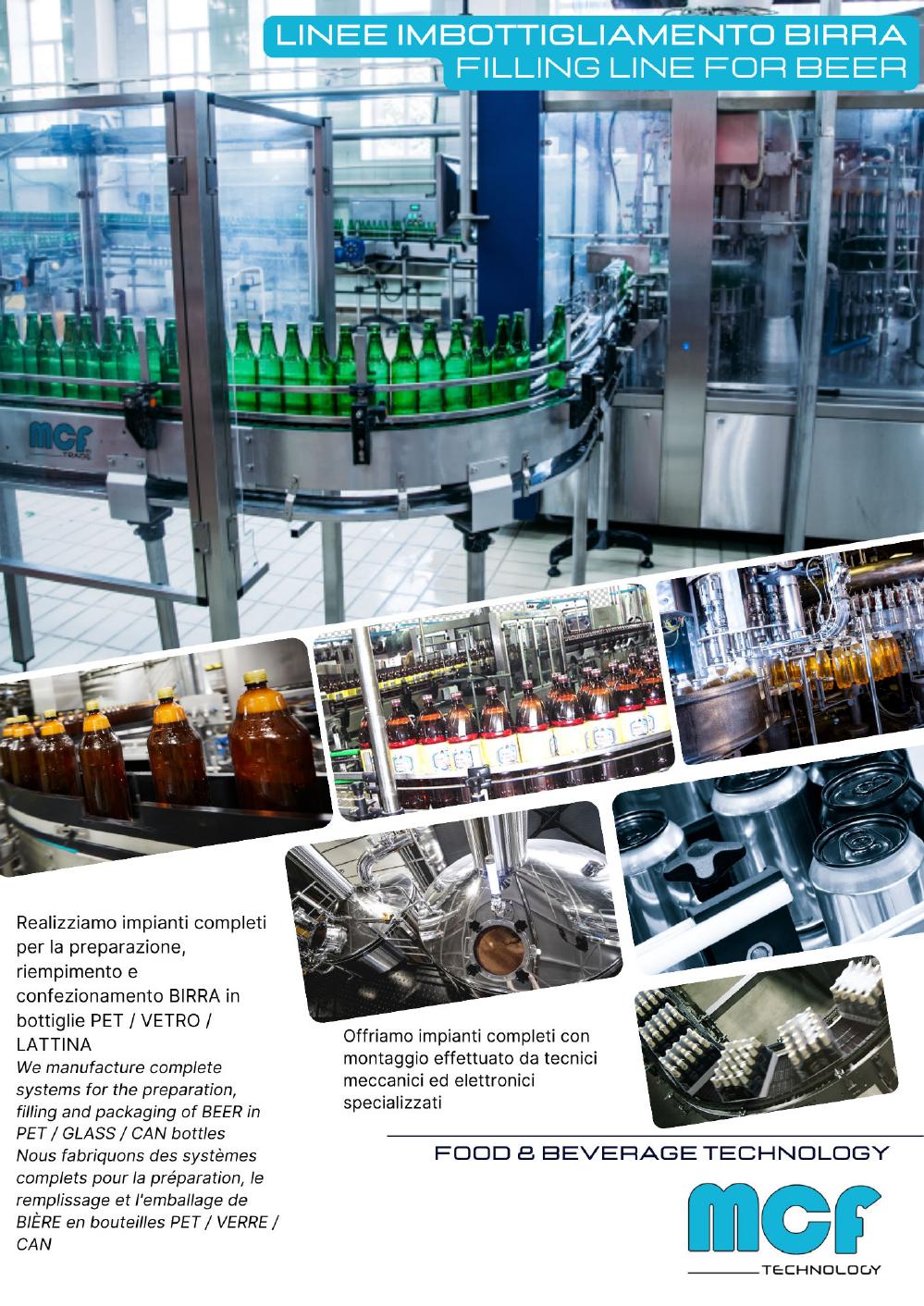
Beer bottling line — PET, glass and can filling
Turnkey brewery filling plant: process, carbonation, isobaric filling, pasteurising and multi-format packaging engineered as a single line.
Finished products: PET, Vetro, Lattina.
Full sheet and technical dataHow to install and operate the beer bottling line — pet, glass & can filling: step-by-step procedure (about 36 working days)
The operating sequence MCF Technology follows to install, commission and start up the beer bottling line — pet, glass & can filling, through to daily operation and planned maintenance. Delivery, erection and on-site service are included worldwide.
- 1. Site survey and utilities check (2 days): Technical survey on the layout of the beer bottling line — pet, glass & can filling: passage heights, flooring and drains, maintenance clearances and availability of steam or hot water for the brewhouse, cooling water and glycol for the fermentation cellar. The final list of customer-side preparations is handed over.
- 2. Shipment, receiving and positioning of the modules (3 days): Worldwide delivery with sea-freight or road packing, unloading and positioning of the modules (Serbatoi di pressione e carbonatore in linea, Riempitrice isobarica con tappatore corona / capsulatore, Pastorizzatore a tunnel o flash pasteurizer) on the areas foreseen by the layout, checking the packing list and the condition of the components.
- 3. Mechanical assembly and piping (15 days): Assembly of the units, conveyor alignment, hygienic welding of the stainless-steel piping and installation of valves and instruments according to the P&ID, supervised on site by MCF Technology technicians.
- 4. Utility hook-ups and electrical connections (4 days): Connection of steam or hot water for the brewhouse, cooling water and glycol for the fermentation cellar, wiring of the electrical cabinet and PLC, earthing, HMI configuration and process recipes for the planned formats (PET, Vetro, Lattina).
- 5. Sanitation, CIP and dry runs (3 days): Washing and passivation of the product-contact surfaces, CIP circuit verification with flow, temperature and detergent-concentration control, tightness tests and dry-run cycles on all modules.
- 6. Functional commissioning and process trials (4 days): hot run of the brewhouse, temperature-ramp calibration, fermenter tightness test and isobaric filling test. Trials are run with the customer's real product and recorded in the commissioning report.
- 7. Production start-up and staff training (5 days): Assisted start-up with continuous production, training of operators and maintenance staff on HMI, format changeover, safety and sanitation, handover of manuals and drawings in the agreed language.
- 8. Daily operation and planned maintenance: Daily operation with fermentation gravity and temperature, CO2 at filling and dissolved oxygen in the bottle. Planned maintenance: heat-exchanger inspection, fermenter gaskets and calibration of temperature and pressure probes. On-site and remote service with critical spare parts agreed in the quotation.
Durations and activities are indicative: the erection, commissioning and training plan is defined in the quotation after the site survey and line sizing. No figure is a contractual performance.
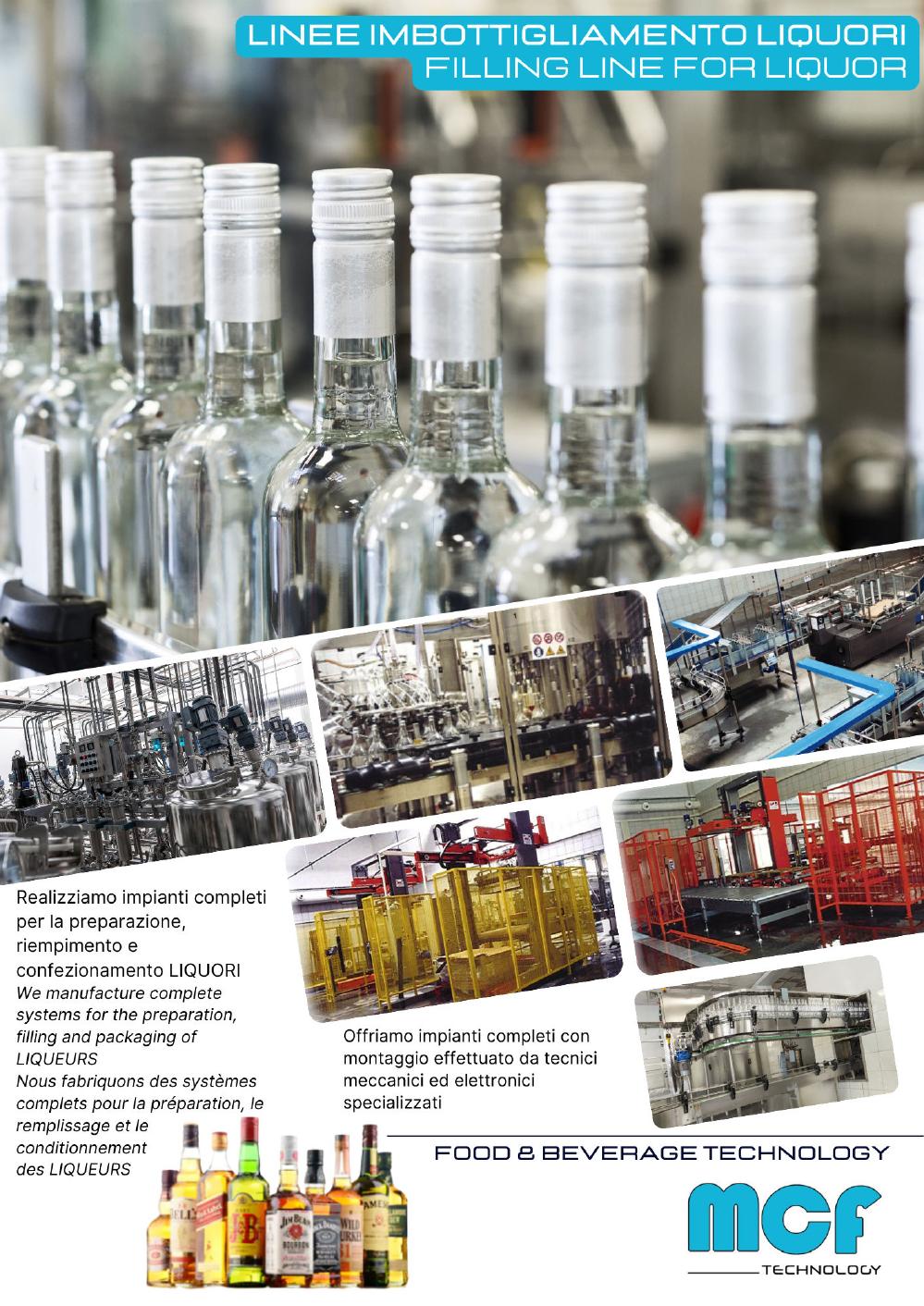
Spirits and liquor bottling line
Bottling plant for liqueurs, bitters and distillates: preparation, high-accuracy volumetric filling, capping, capsuling, labelling and packaging.
Full sheet and technical dataHow to install and operate the spirits & liquor bottling line: step-by-step procedure (about 31 working days)
The operating sequence MCF Technology follows to install, commission and start up the spirits & liquor bottling line, through to daily operation and planned maintenance. Delivery, erection and on-site service are included worldwide.
- 1. Site survey and utilities check (2 days): Technical survey on the layout of the spirits & liquor bottling line: passage heights, flooring and drains, maintenance clearances and availability of demineralised water, alcohol storage in an ATEX-classified area and vapour extraction. The final list of customer-side preparations is handed over.
- 2. Shipment, receiving and positioning of the modules (3 days): Worldwide delivery with sea-freight or road packing, unloading and positioning of the modules (Preparazione e filtrazione del prodotto, Riempitrice a livello/volumetrica con azoto, Tappatore multi-testa e capsulatrice) on the areas foreseen by the layout, checking the packing list and the condition of the components.
- 3. Mechanical assembly and piping (10 days): Assembly of the units, conveyor alignment, hygienic welding of the stainless-steel piping and installation of valves and instruments according to the P&ID, supervised on site by MCF Technology technicians.
- 4. Utility hook-ups and electrical connections (4 days): Connection of demineralised water, alcohol storage in an ATEX-classified area and vapour extraction, wiring of the electrical cabinet and PLC, earthing, HMI configuration and process recipes.
- 5. Sanitation, CIP and dry runs (3 days): Washing and passivation of the product-contact surfaces, CIP circuit verification with flow, temperature and detergent-concentration control, tightness tests and dry-run cycles on all modules.
- 6. Functional commissioning and process trials (4 days): verification of dilutions and alcoholic strength, filtration test and filling test on the declared glass formats. Trials are run with the customer's real product and recorded in the commissioning report.
- 7. Production start-up and staff training (5 days): Assisted start-up with continuous production, training of operators and maintenance staff on HMI, format changeover, safety and sanitation, handover of manuals and drawings in the agreed language.
- 8. Daily operation and planned maintenance: Daily operation with alcoholic strength and clarity, sugar and flavour dosing, bottle fill level. Planned maintenance: filter replacement, dosing-pump check and seal inspection in the classified area. On-site and remote service with critical spare parts agreed in the quotation.
Durations and activities are indicative: the erection, commissioning and training plan is defined in the quotation after the site survey and line sizing. No figure is a contractual performance.
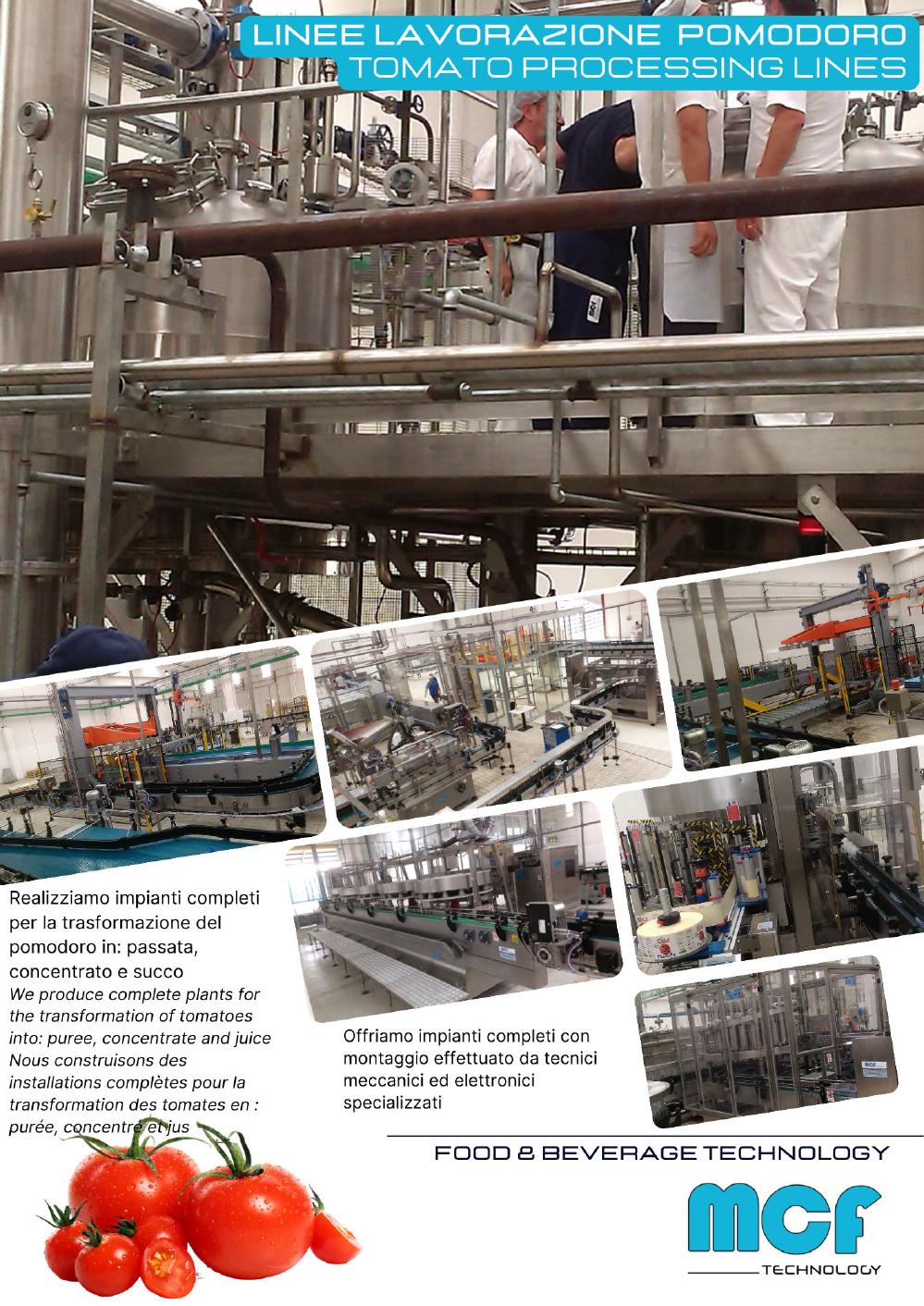
Tomato processing plant — paste, pulp and passata lines
Complete tomato lines: reception and washing, extraction, evaporation, sterilising and aseptic or jar filling, engineered for industrial season campaigns.
Finished products: Passata, Concentrato, Succo.
Full sheet and technical dataHow to install and operate the tomato processing plant — paste, puree & juice line: step-by-step procedure (about 41 working days)
The operating sequence MCF Technology follows to install, commission and start up the tomato processing plant — paste, puree & juice line, through to daily operation and planned maintenance. Delivery, erection and on-site service are included worldwide.
- 1. Site survey and utilities check (2 days): Technical survey on the layout of the tomato processing plant — paste, puree & juice line: passage heights, flooring and drains, maintenance clearances and availability of process steam, closed-circuit cooling water and a drain for washing water. The final list of customer-side preparations is handed over.
- 2. Shipment, receiving and positioning of the modules (3 days): Worldwide delivery with sea-freight or road packing, unloading and positioning of the modules (Ricevimento, lavaggio, cernita ottica e selezione, Hot/cold break, raffinazione e serbatoi tampone, Evaporatore e sterilizzatore tubolare) on the areas foreseen by the layout, checking the packing list and the condition of the components.
- 3. Mechanical assembly and piping (20 days): Assembly of the units, conveyor alignment, hygienic welding of the stainless-steel piping and installation of valves and instruments according to the P&ID, supervised on site by MCF Technology technicians.
- 4. Utility hook-ups and electrical connections (4 days): Connection of process steam, closed-circuit cooling water and a drain for washing water, wiring of the electrical cabinet and PLC, earthing, HMI configuration and process recipes for the planned formats (Passata, Concentrato, Succo).
- 5. Sanitation, CIP and dry runs (3 days): Washing and passivation of the product-contact surfaces, CIP circuit verification with flow, temperature and detergent-concentration control, tightness tests and dry-run cycles on all modules.
- 6. Functional commissioning and process trials (4 days): hot run of evaporator and steriliser, Brix concentration curve and aseptic filling test on the planned drums/containers. Trials are run with the customer's real product and recorded in the commissioning report.
- 7. Production start-up and staff training (5 days): Assisted start-up with continuous production, training of operators and maintenance staff on HMI, format changeover, safety and sanitation, handover of manuals and drawings in the agreed language.
- 8. Daily operation and planned maintenance: Daily operation with Brix and pH of the paste, sterilisation temperatures and aseptic bag integrity. Planned maintenance: cleaning of tube bundles and plates, aseptic valve checks and calibration of in-line refractometers. On-site and remote service with critical spare parts agreed in the quotation.
Durations and activities are indicative: the erection, commissioning and training plan is defined in the quotation after the site survey and line sizing. No figure is a contractual performance.
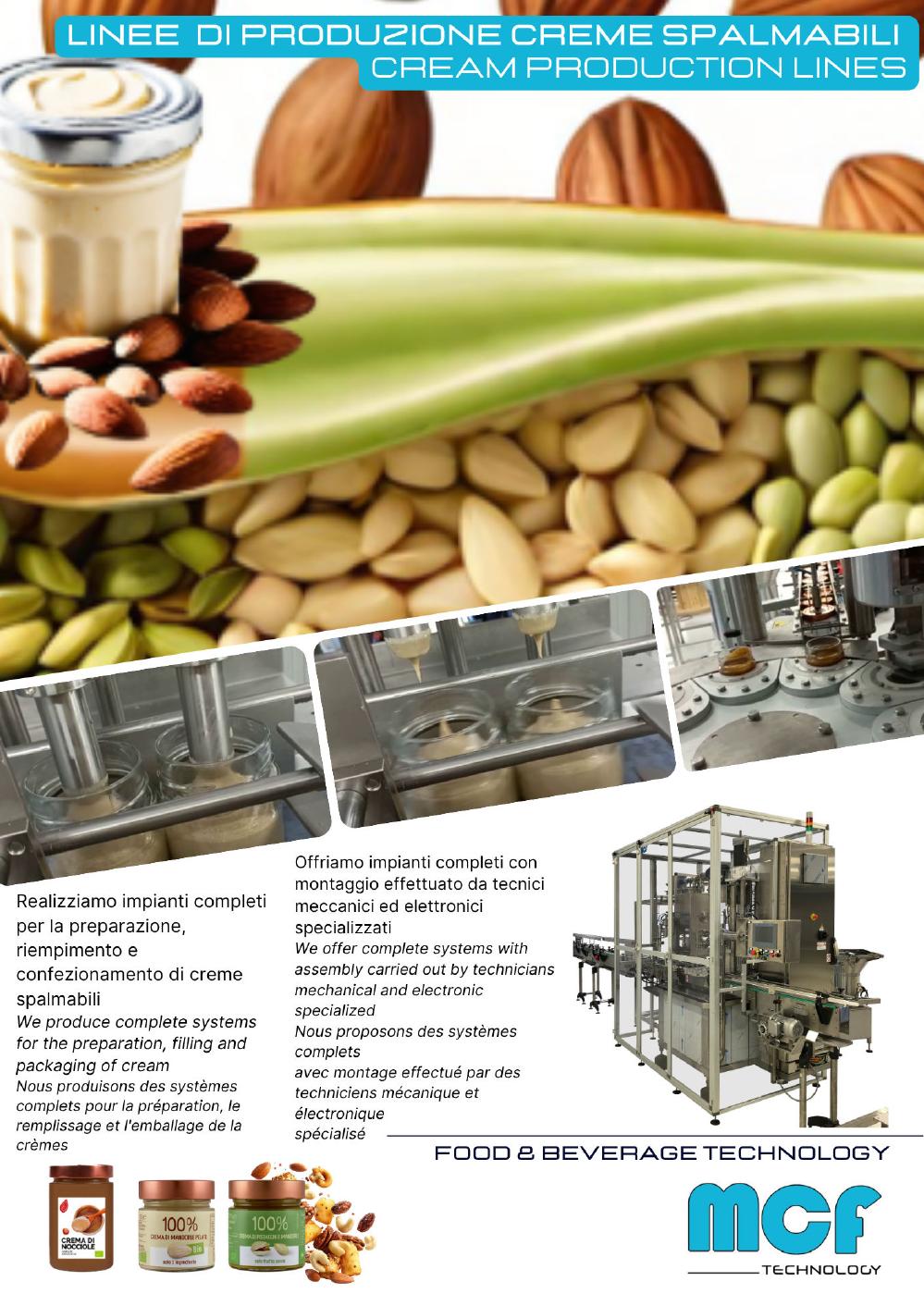
Nut and cocoa spread production line
Plant for hazelnut, cocoa and nut spreads: refining, vacuum mixing, high-pressure homogenising, jar dosing and packaging as one continuous line.
Finished products: Crema di nocciole, Crema di mandorle, Crema di pistacchi.
Full sheet and technical dataHow to install and operate the nut cream & spread production line: step-by-step procedure (about 33 working days)
The operating sequence MCF Technology follows to install, commission and start up the nut cream & spread production line, through to daily operation and planned maintenance. Delivery, erection and on-site service are included worldwide.
- 1. Site survey and utilities check (2 days): Technical survey on the layout of the nut cream & spread production line: passage heights, flooring and drains, maintenance clearances and availability of steam or superheated water for the turbo-emulsifiers, cooling water and food-grade compressed air. The final list of customer-side preparations is handed over.
- 2. Shipment, receiving and positioning of the modules (3 days): Worldwide delivery with sea-freight or road packing, unloading and positioning of the modules (Dosaggio ingredienti e serbatoi riscaldati con agitatore, Mulino/raffinatore e omogeneizzatore ad alta pressione, Scambiatore a superficie raschiata per il raffreddamento) on the areas foreseen by the layout, checking the packing list and the condition of the components.
- 3. Mechanical assembly and piping (12 days): Assembly of the units, conveyor alignment, hygienic welding of the stainless-steel piping and installation of valves and instruments according to the P&ID, supervised on site by MCF Technology technicians.
- 4. Utility hook-ups and electrical connections (4 days): Connection of steam or superheated water for the turbo-emulsifiers, cooling water and food-grade compressed air, wiring of the electrical cabinet and PLC, earthing, HMI configuration and process recipes for the planned formats (Crema di nocciole, Crema di mandorle, Crema di pistacchi).
- 5. Sanitation, CIP and dry runs (3 days): Washing and passivation of the product-contact surfaces, CIP circuit verification with flow, temperature and detergent-concentration control, tightness tests and dry-run cycles on all modules.
- 6. Functional commissioning and process trials (4 days): emulsion test and particle-size check, vacuum tightness of the turbo-emulsifiers and hot filling into jars. Trials are run with the customer's real product and recorded in the commissioning report.
- 7. Production start-up and staff training (5 days): Assisted start-up with continuous production, training of operators and maintenance staff on HMI, format changeover, safety and sanitation, handover of manuals and drawings in the agreed language.
- 8. Daily operation and planned maintenance: Daily operation with viscosity and filling temperature, jar net weight and cap sealing. Planned maintenance: mixer mechanical-seal check, refiner cleaning and load-cell calibration. On-site and remote service with critical spare parts agreed in the quotation.
Durations and activities are indicative: the erection, commissioning and training plan is defined in the quotation after the site survey and line sizing. No figure is a contractual performance.
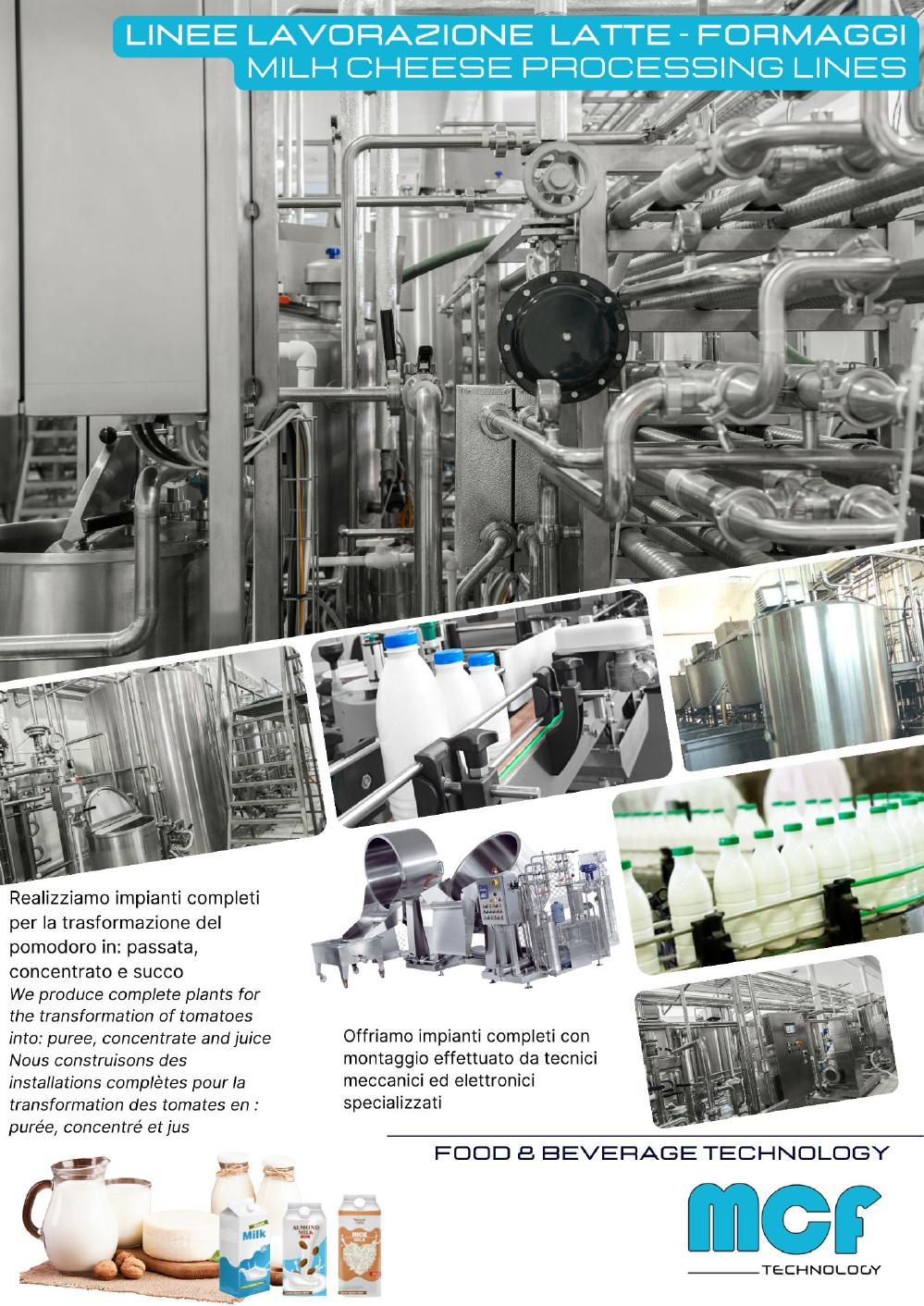
Dairy processing plant — milk, UHT and cheese lines
Complete dairy lines for fresh and UHT milk, yoghurt and cheese: reception, standardising, pasteurising, homogenising, cheese vats and filling.
Finished products: Latte, Bevande vegetali, Formaggi.
Full sheet and technical dataHow to install and operate the uht milk processing plant & cheese production line: step-by-step procedure (about 36 working days)
The operating sequence MCF Technology follows to install, commission and start up the uht milk processing plant & cheese production line, through to daily operation and planned maintenance. Delivery, erection and on-site service are included worldwide.
- 1. Site survey and utilities check (2 days): Technical survey on the layout of the uht milk processing plant & cheese production line: passage heights, flooring and drains, maintenance clearances and availability of steam for pasteurisation, chilled water, food-grade compressed air and a dairy drain. The final list of customer-side preparations is handed over.
- 2. Shipment, receiving and positioning of the modules (3 days): Worldwide delivery with sea-freight or road packing, unloading and positioning of the modules (Ricevimento latte, deaeratore, scrematrice e standardizzazione, Pastorizzatore a piastre e omogeneizzatore, Polivalenti di coagulazione, filatrici, presse e salamoia) on the areas foreseen by the layout, checking the packing list and the condition of the components.
- 3. Mechanical assembly and piping (15 days): Assembly of the units, conveyor alignment, hygienic welding of the stainless-steel piping and installation of valves and instruments according to the P&ID, supervised on site by MCF Technology technicians.
- 4. Utility hook-ups and electrical connections (4 days): Connection of steam for pasteurisation, chilled water, food-grade compressed air and a dairy drain, wiring of the electrical cabinet and PLC, earthing, HMI configuration and process recipes for the planned formats (Latte, Bevande vegetali, Formaggi).
- 5. Sanitation, CIP and dry runs (3 days): Washing and passivation of the product-contact surfaces, CIP circuit verification with flow, temperature and detergent-concentration control, tightness tests and dry-run cycles on all modules.
- 6. Functional commissioning and process trials (4 days): pasteurisation test with recorded thermal curve, flow-diversion valve tightness test and cheese-making trial. Trials are run with the customer's real product and recorded in the commissioning report.
- 7. Production start-up and staff training (5 days): Assisted start-up with continuous production, training of operators and maintenance staff on HMI, format changeover, safety and sanitation, handover of manuals and drawings in the agreed language.
- 8. Daily operation and planned maintenance: Daily operation with pasteurisation temperature and holding time, curd pH, yield and storage temperature. Planned maintenance: heat-exchanger plate inspection, probe calibration and hygienic safety-valve checks. On-site and remote service with critical spare parts agreed in the quotation.
Durations and activities are indicative: the erection, commissioning and training plan is defined in the quotation after the site survey and line sizing. No figure is a contractual performance.
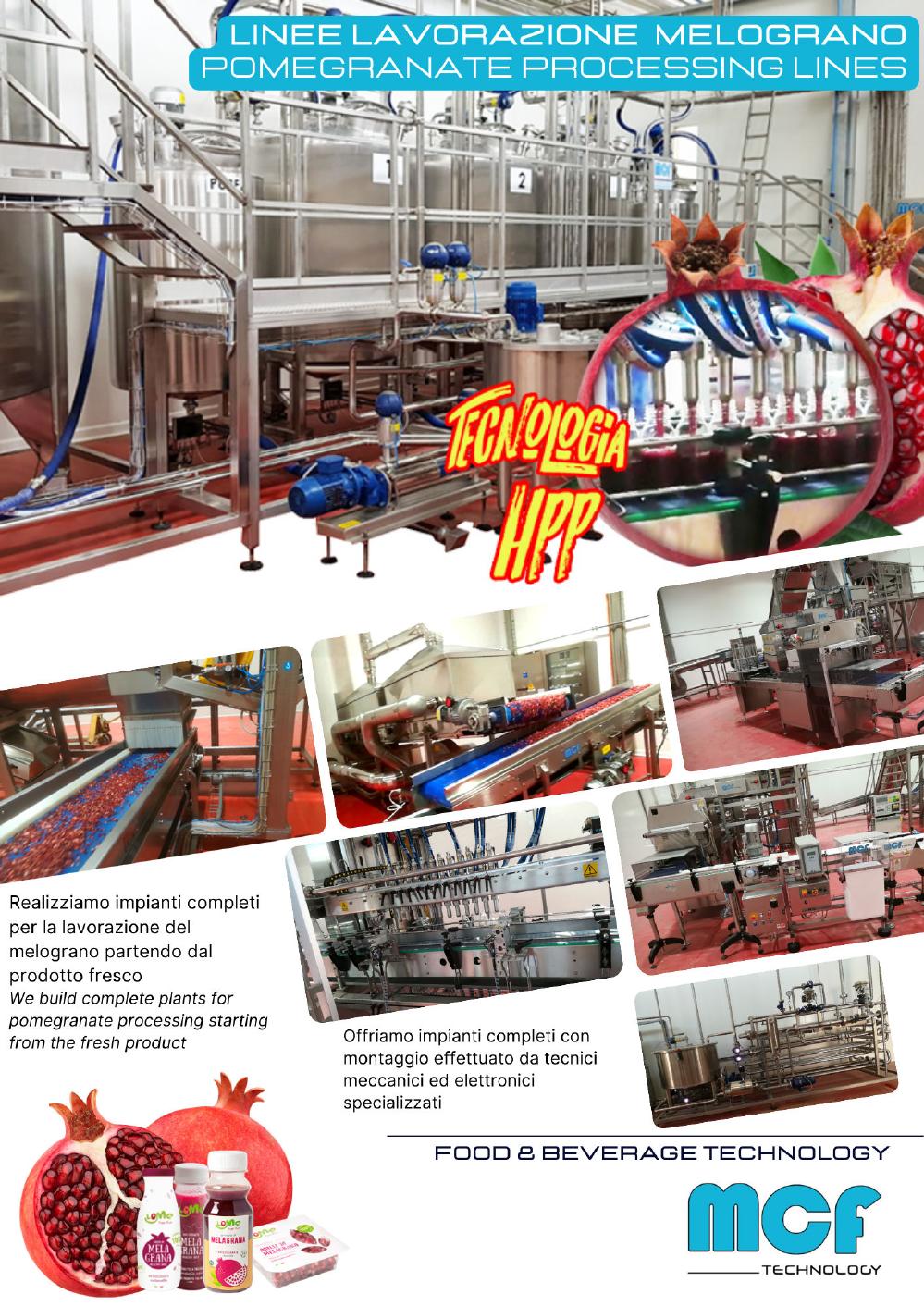
Pomegranate juice processing plant
Dedicated pomegranate line: gentle deseeding, pressing, clarifying, optional concentration, pasteurising and aseptic or bottle filling.
Finished products: Succo di melograno, Concentrato.
Full sheet and technical dataHow to install and operate the pomegranate juice processing line: step-by-step procedure (about 33 working days)
The operating sequence MCF Technology follows to install, commission and start up the pomegranate juice processing line, through to daily operation and planned maintenance. Delivery, erection and on-site service are included worldwide.
- 1. Site survey and utilities check (2 days): Technical survey on the layout of the pomegranate juice processing line: passage heights, flooring and drains, maintenance clearances and availability of washing water, steam for heat treatment and compressed air for sorting and filling. The final list of customer-side preparations is handed over.
- 2. Shipment, receiving and positioning of the modules (3 days): Worldwide delivery with sea-freight or road packing, unloading and positioning of the modules (Lavaggio, cernita e apertura del frutto, Estrattore a bassa pressione e separazione arilli, Chiarifica/filtrazione, pastorizzatore e deaeratore) on the areas foreseen by the layout, checking the packing list and the condition of the components.
- 3. Mechanical assembly and piping (12 days): Assembly of the units, conveyor alignment, hygienic welding of the stainless-steel piping and installation of valves and instruments according to the P&ID, supervised on site by MCF Technology technicians.
- 4. Utility hook-ups and electrical connections (4 days): Connection of washing water, steam for heat treatment and compressed air for sorting and filling, wiring of the electrical cabinet and PLC, earthing, HMI configuration and process recipes for the planned formats (Succo di melograno, Concentrato).
- 5. Sanitation, CIP and dry runs (3 days): Washing and passivation of the product-contact surfaces, CIP circuit verification with flow, temperature and detergent-concentration control, tightness tests and dry-run cycles on all modules.
- 6. Functional commissioning and process trials (4 days): extraction and juice-yield test, peel and seed separation check, pasteurisation and filling test. Trials are run with the customer's real product and recorded in the commissioning report.
- 7. Production start-up and staff training (5 days): Assisted start-up with continuous production, training of operators and maintenance staff on HMI, format changeover, safety and sanitation, handover of manuals and drawings in the agreed language.
- 8. Daily operation and planned maintenance: Daily operation with extraction yield, juice Brix and pH, filter integrity. Planned maintenance: replacement of extraction screens and baskets, pump and gasket checks. On-site and remote service with critical spare parts agreed in the quotation.
Durations and activities are indicative: the erection, commissioning and training plan is defined in the quotation after the site survey and line sizing. No figure is a contractual performance.
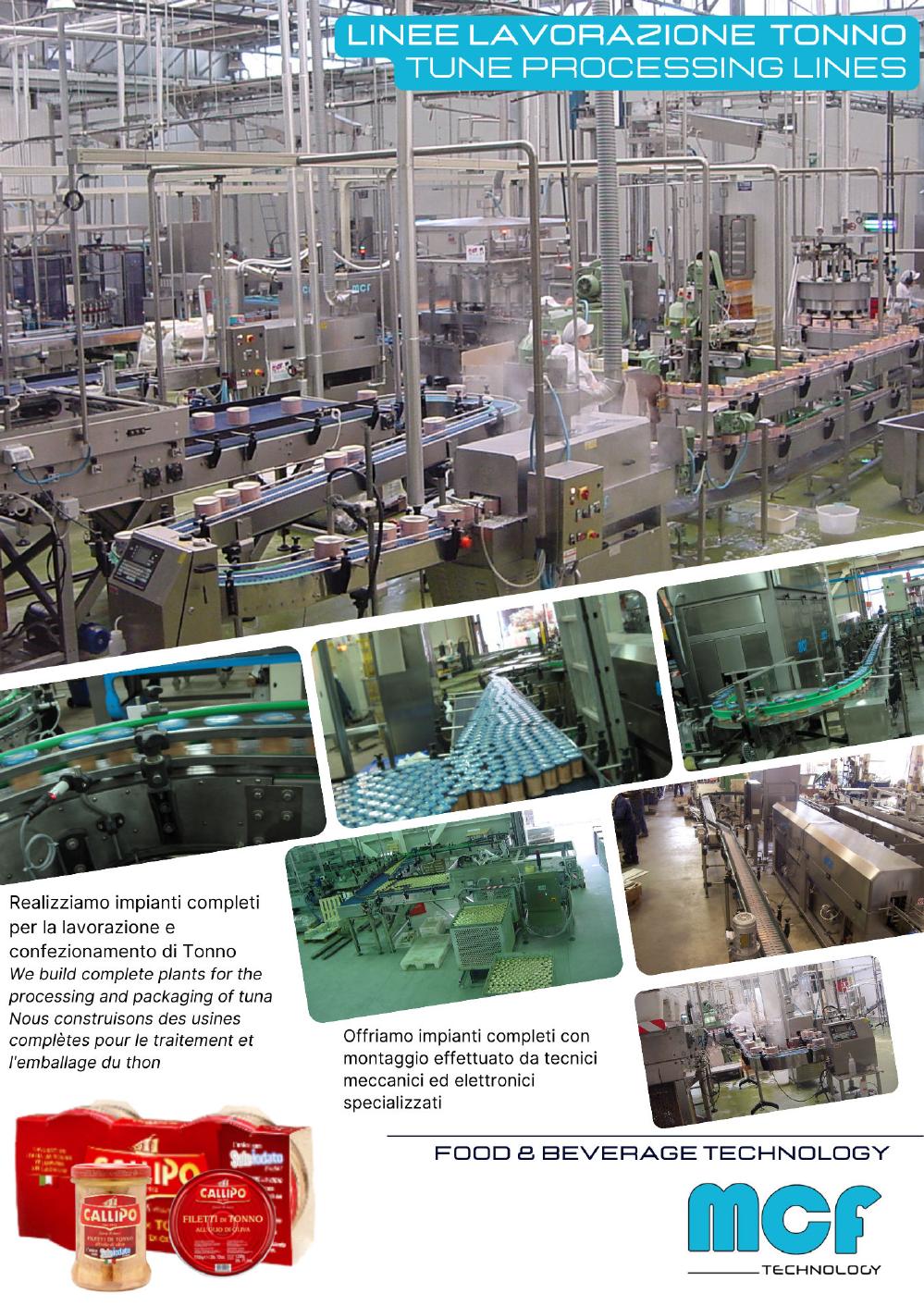
Tuna and fish canning plant
Complete lines for canned or retort-pouch tuna and fish: reception, cooking, cleaning, dosing, liquid addition, seaming and sterilising.
Finished products: Tonno in scatola, Vetro, Pouch.
Full sheet and technical dataHow to install and operate the tuna processing and canning line: step-by-step procedure (about 41 working days)
The operating sequence MCF Technology follows to install, commission and start up the tuna processing and canning line, through to daily operation and planned maintenance. Delivery, erection and on-site service are included worldwide.
- 1. Site survey and utilities check (2 days): Technical survey on the layout of the tuna processing and canning line: passage heights, flooring and drains, maintenance clearances and availability of steam for cooking and sterilisation, cooling water, compressed air and a treated-effluent drain. The final list of customer-side preparations is handed over.
- 2. Shipment, receiving and positioning of the modules (3 days): Worldwide delivery with sea-freight or road packing, unloading and positioning of the modules (Ricevimento, scongelamento e precottura, Pulitura, riempimento scatole e dosaggio liquido di governo, Aggraffatrice sottovuoto e lavaggio contenitori) on the areas foreseen by the layout, checking the packing list and the condition of the components.
- 3. Mechanical assembly and piping (20 days): Assembly of the units, conveyor alignment, hygienic welding of the stainless-steel piping and installation of valves and instruments according to the P&ID, supervised on site by MCF Technology technicians.
- 4. Utility hook-ups and electrical connections (4 days): Connection of steam for cooking and sterilisation, cooling water, compressed air and a treated-effluent drain, wiring of the electrical cabinet and PLC, earthing, HMI configuration and process recipes for the planned formats (Tonno in scatola, Vetro, Pouch).
- 5. Sanitation, CIP and dry runs (3 days): Washing and passivation of the product-contact surfaces, CIP circuit verification with flow, temperature and detergent-concentration control, tightness tests and dry-run cycles on all modules.
- 6. Functional commissioning and process trials (4 days): cooking trial with core-temperature curve, validation of the retort sterilisation cycle and seam tightness test on the cans. Trials are run with the customer's real product and recorded in the commissioning report.
- 7. Production start-up and staff training (5 days): Assisted start-up with continuous production, training of operators and maintenance staff on HMI, format changeover, safety and sanitation, handover of manuals and drawings in the agreed language.
- 8. Daily operation and planned maintenance: Daily operation with core temperature, drained weight, can seam integrity and vacuum. Planned maintenance: retort and safety-valve checks, seamer calibration and process-probe verification. On-site and remote service with critical spare parts agreed in the quotation.
Durations and activities are indicative: the erection, commissioning and training plan is defined in the quotation after the site survey and line sizing. No figure is a contractual performance.
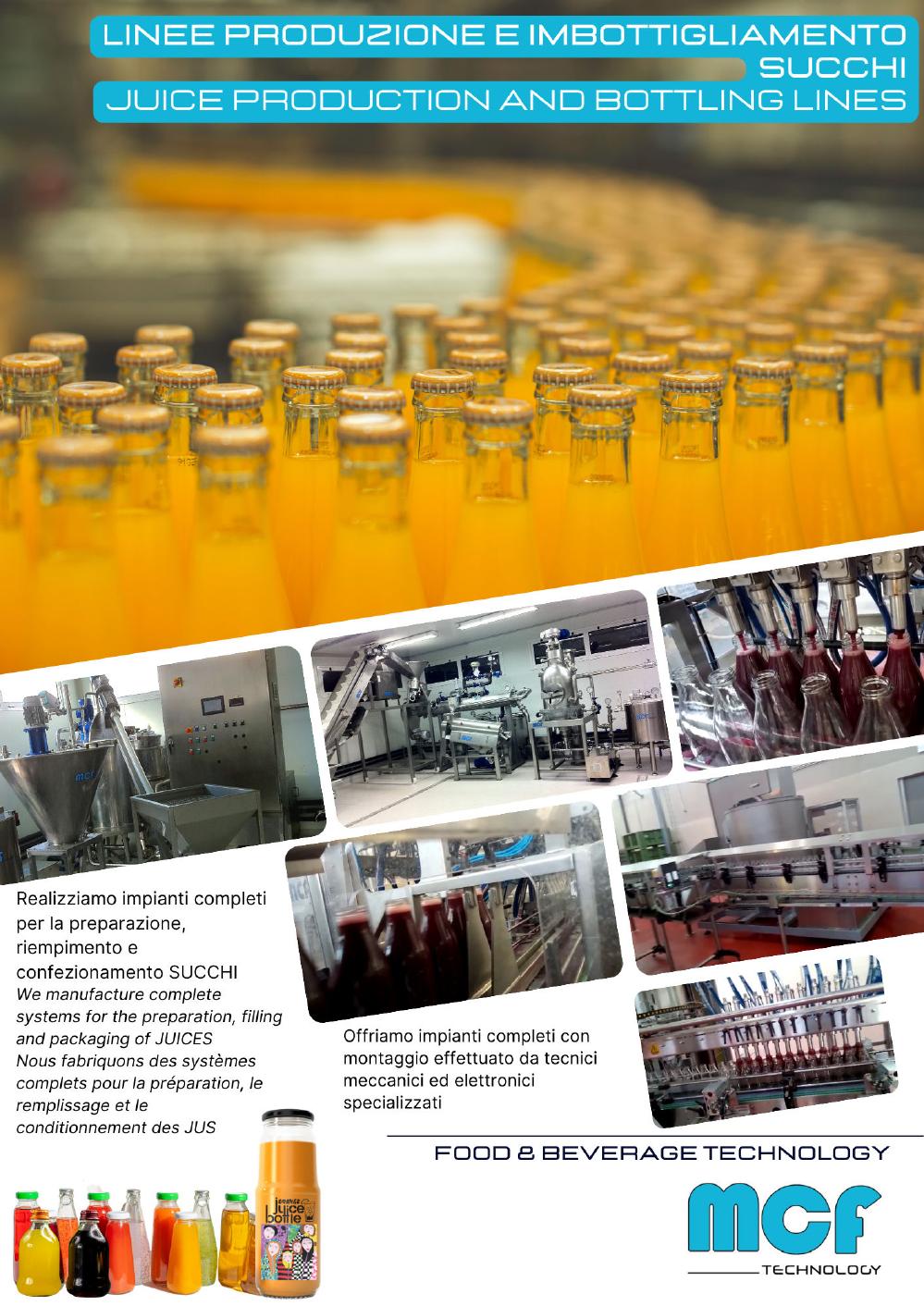
Fruit juice processing and filling line
Plant for juices, nectars and fruit drinks: syrup preparation, blending, deaeration, pasteurising and aseptic or hot-fill packaging.
Full sheet and technical dataHow to install and operate the fruit juice processing line & aseptic filling machine: step-by-step procedure (about 35 working days)
The operating sequence MCF Technology follows to install, commission and start up the fruit juice processing line & aseptic filling machine, through to daily operation and planned maintenance. Delivery, erection and on-site service are included worldwide.
- 1. Site survey and utilities check (2 days): Technical survey on the layout of the fruit juice processing line & aseptic filling machine: passage heights, flooring and drains, maintenance clearances and availability of steam, cooling water, filtered compressed air and treated water for dilutions. The final list of customer-side preparations is handed over.
- 2. Shipment, receiving and positioning of the modules (3 days): Worldwide delivery with sea-freight or road packing, unloading and positioning of the modules (Preparazione frutta: lavaggio, denocciolatura, raffinazione, Serbatoi di miscelazione e correzione Brix, Deaeratore, omogeneizzatore e sterilizzatore) on the areas foreseen by the layout, checking the packing list and the condition of the components.
- 3. Mechanical assembly and piping (14 days): Assembly of the units, conveyor alignment, hygienic welding of the stainless-steel piping and installation of valves and instruments according to the P&ID, supervised on site by MCF Technology technicians.
- 4. Utility hook-ups and electrical connections (4 days): Connection of steam, cooling water, filtered compressed air and treated water for dilutions, wiring of the electrical cabinet and PLC, earthing, HMI configuration and process recipes.
- 5. Sanitation, CIP and dry runs (3 days): Washing and passivation of the product-contact surfaces, CIP circuit verification with flow, temperature and detergent-concentration control, tightness tests and dry-run cycles on all modules.
- 6. Functional commissioning and process trials (4 days): hot run of the pasteuriser, deaeration and homogenisation checks, hot-fill or aseptic filling test. Trials are run with the customer's real product and recorded in the commissioning report.
- 7. Production start-up and staff training (5 days): Assisted start-up with continuous production, training of operators and maintenance staff on HMI, format changeover, safety and sanitation, handover of manuals and drawings in the agreed language.
- 8. Daily operation and planned maintenance: Daily operation with Brix, pH and filling temperature, fill level and closure integrity. Planned maintenance: plate and homogeniser cleaning, piston and valve checks, in-line instrument calibration. On-site and remote service with critical spare parts agreed in the quotation.
Durations and activities are indicative: the erection, commissioning and training plan is defined in the quotation after the site survey and line sizing. No figure is a contractual performance.
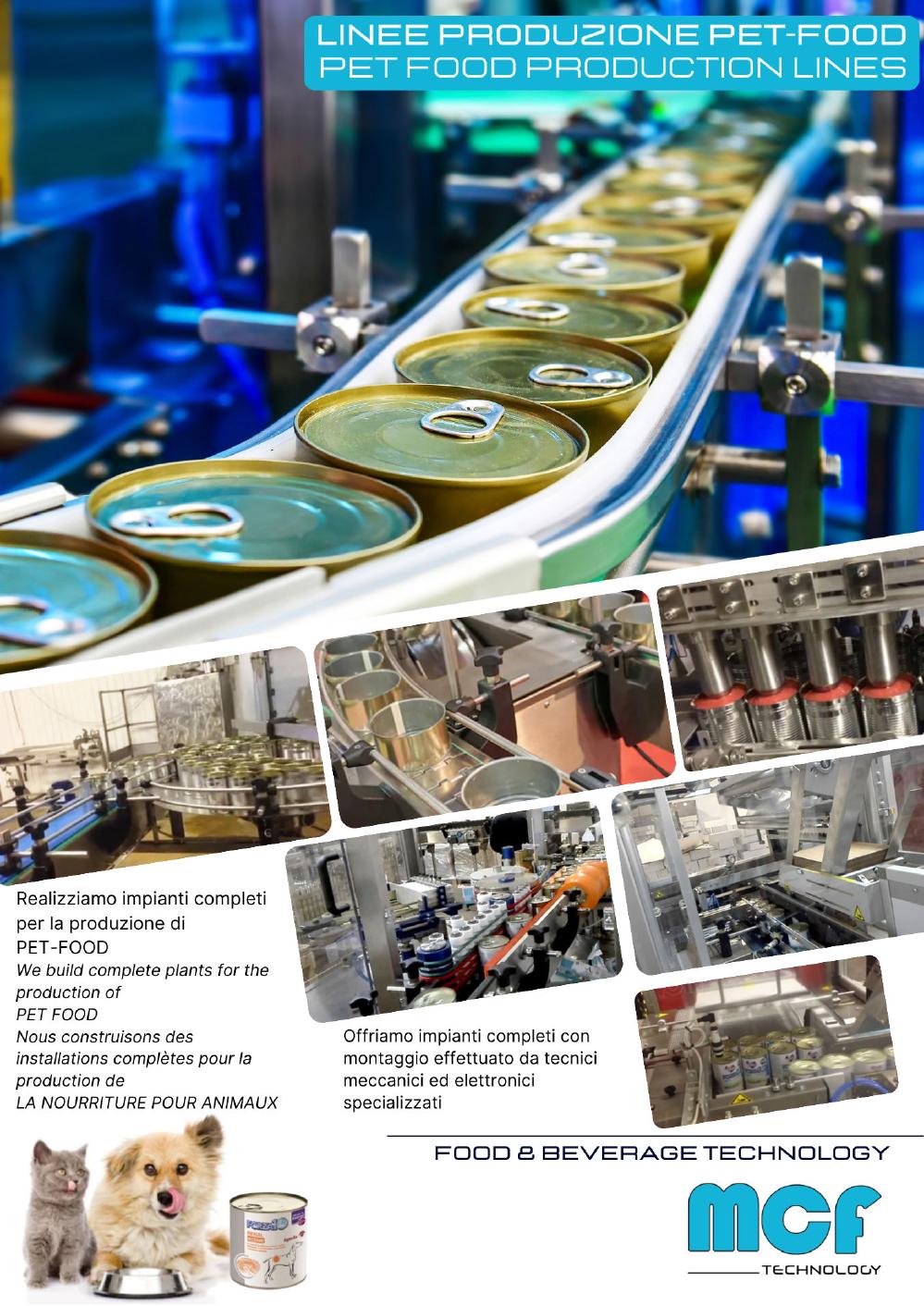
Pet food processing and filling line
Plants for wet pet food: recipe preparation, dosing into cans, trays or retort pouches, seaming, sterilising and end-of-line packaging.
Full sheet and technical dataHow to install and operate the pet food processing line — wet & dry, can & pouch: step-by-step procedure (about 35 working days)
The operating sequence MCF Technology follows to install, commission and start up the pet food processing line — wet & dry, can & pouch, through to daily operation and planned maintenance. Delivery, erection and on-site service are included worldwide.
- 1. Site survey and utilities check (2 days): Technical survey on the layout of the pet food processing line — wet & dry, can & pouch: passage heights, flooring and drains, maintenance clearances and availability of steam for cooking, compressed air, dust extraction and power supply for extrusion or cooking. The final list of customer-side preparations is handed over.
- 2. Shipment, receiving and positioning of the modules (3 days): Worldwide delivery with sea-freight or road packing, unloading and positioning of the modules (Ricevimento materie prime, macinazione ed emulsificazione, Cottura e dosaggio in contenitore, Aggraffatura/termosaldatura e autoclave) on the areas foreseen by the layout, checking the packing list and the condition of the components.
- 3. Mechanical assembly and piping (14 days): Assembly of the units, conveyor alignment, hygienic welding of the stainless-steel piping and installation of valves and instruments according to the P&ID, supervised on site by MCF Technology technicians.
- 4. Utility hook-ups and electrical connections (4 days): Connection of steam for cooking, compressed air, dust extraction and power supply for extrusion or cooking, wiring of the electrical cabinet and PLC, earthing, HMI configuration and process recipes.
- 5. Sanitation, CIP and dry runs (3 days): Washing and passivation of the product-contact surfaces, CIP circuit verification with flow, temperature and detergent-concentration control, tightness tests and dry-run cycles on all modules.
- 6. Functional commissioning and process trials (4 days): recipe trial with moisture and kibble-size verification, dosing-unit calibration and packaging test on the planned formats. Trials are run with the customer's real product and recorded in the commissioning report.
- 7. Production start-up and staff training (5 days): Assisted start-up with continuous production, training of operators and maintenance staff on HMI, format changeover, safety and sanitation, handover of manuals and drawings in the agreed language.
- 8. Daily operation and planned maintenance: Daily operation with cooking moisture and temperature, portion weight and seal integrity. Planned maintenance: screw and extrusion-worm checks, doser cleaning and sealing-bar inspection. On-site and remote service with critical spare parts agreed in the quotation.
Durations and activities are indicative: the erection, commissioning and training plan is defined in the quotation after the site survey and line sizing. No figure is a contractual performance.
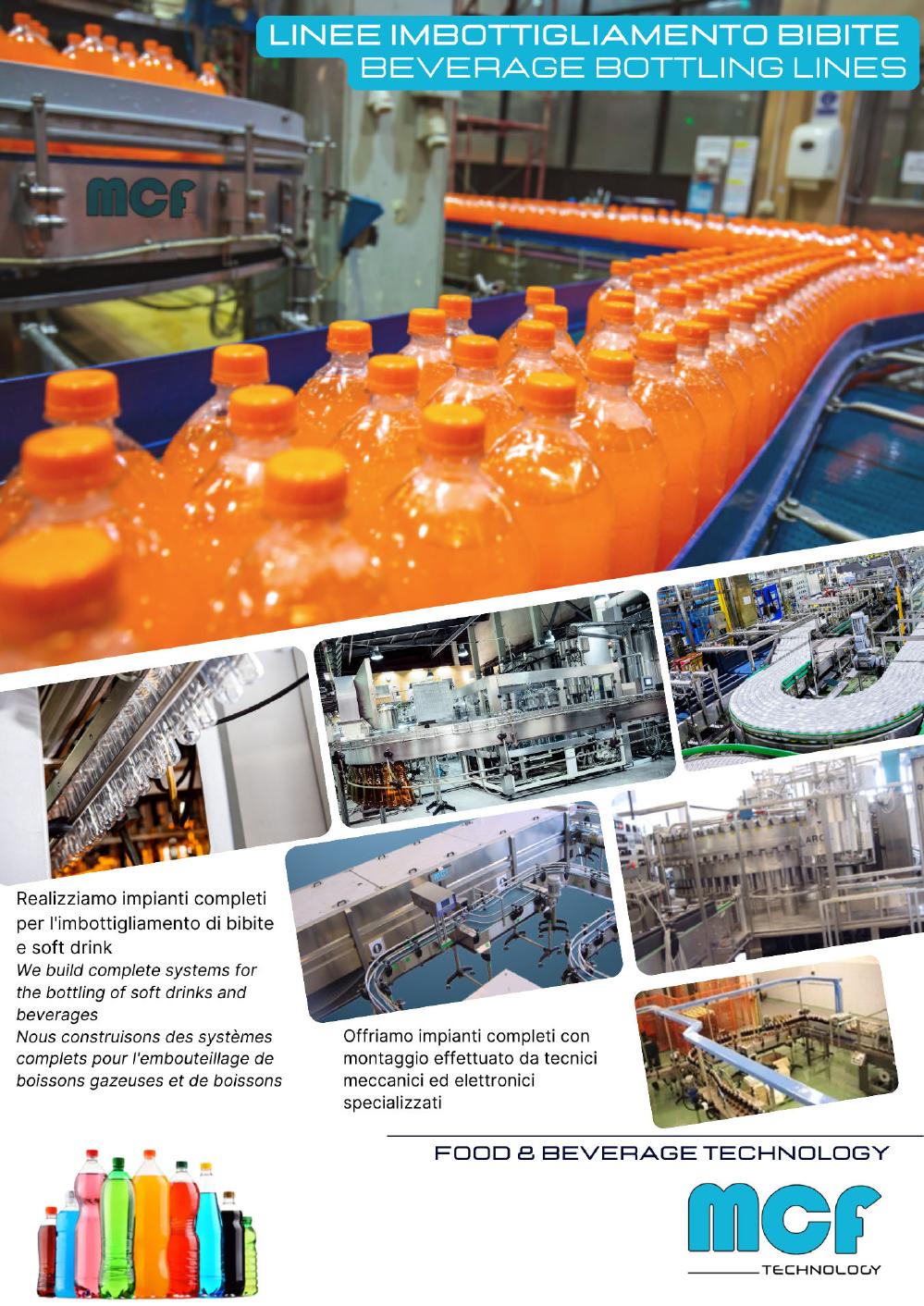
Soft drink bottling line — carbonated beverages
Plant for carbonated soft drinks: syrup preparation, premix, carbonation, isobaric filling and multi-format end-of-line packaging.
Full sheet and technical dataHow to install and operate the soft drink bottling line & beverage filling equipment: step-by-step procedure (about 35 working days)
The operating sequence MCF Technology follows to install, commission and start up the soft drink bottling line & beverage filling equipment, through to daily operation and planned maintenance. Delivery, erection and on-site service are included worldwide.
- 1. Site survey and utilities check (2 days): Technical survey on the layout of the soft drink bottling line & beverage filling equipment: passage heights, flooring and drains, maintenance clearances and availability of food-grade CO2, treated water, chilled water and filtered compressed air. The final list of customer-side preparations is handed over.
- 2. Shipment, receiving and positioning of the modules (3 days): Worldwide delivery with sea-freight or road packing, unloading and positioning of the modules (Sala sciroppi con dosaggio zucchero e aromi, Carbonatore/premix e serbatoi di pressione, Blocco risciacquo–riempimento–tappatura isobarico) on the areas foreseen by the layout, checking the packing list and the condition of the components.
- 3. Mechanical assembly and piping (14 days): Assembly of the units, conveyor alignment, hygienic welding of the stainless-steel piping and installation of valves and instruments according to the P&ID, supervised on site by MCF Technology technicians.
- 4. Utility hook-ups and electrical connections (4 days): Connection of food-grade CO2, treated water, chilled water and filtered compressed air, wiring of the electrical cabinet and PLC, earthing, HMI configuration and process recipes.
- 5. Sanitation, CIP and dry runs (3 days): Washing and passivation of the product-contact surfaces, CIP circuit verification with flow, temperature and detergent-concentration control, tightness tests and dry-run cycles on all modules.
- 6. Functional commissioning and process trials (4 days): premix and carbonation-level calibration, isobaric filling test and cap tightness check. Trials are run with the customer's real product and recorded in the commissioning report.
- 7. Production start-up and staff training (5 days): Assisted start-up with continuous production, training of operators and maintenance staff on HMI, format changeover, safety and sanitation, handover of manuals and drawings in the agreed language.
- 8. Daily operation and planned maintenance: Daily operation with Brix and CO2 volumes, fill level, closure torque and bottle integrity. Planned maintenance: saturator and carbonator checks, isobaric valve gaskets and flow-meter calibration. On-site and remote service with critical spare parts agreed in the quotation.
Durations and activities are indicative: the erection, commissioning and training plan is defined in the quotation after the site survey and line sizing. No figure is a contractual performance.
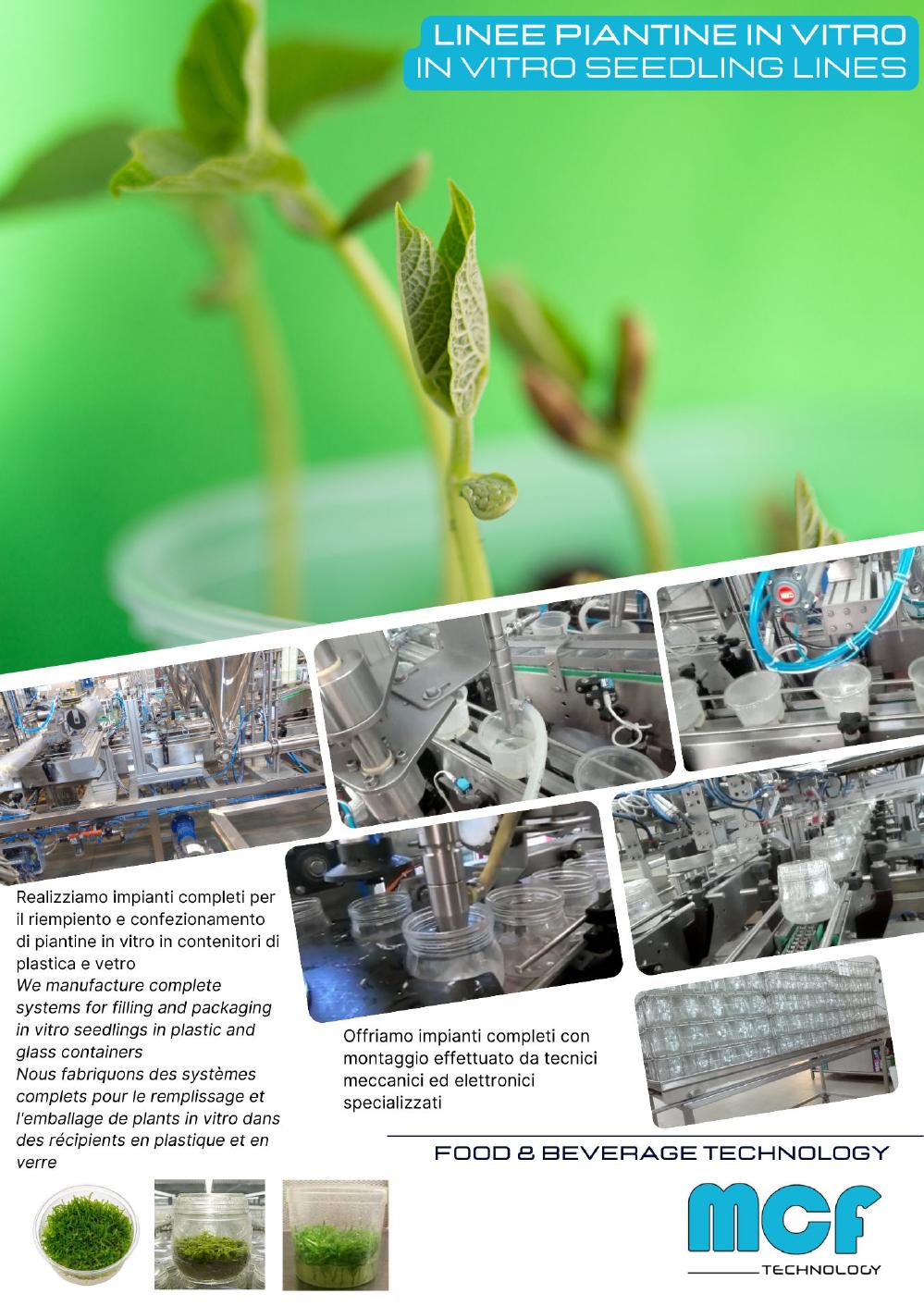
In vitro plantlet filling line
Micropropagation plant: substrate preparation and dosing, sterile container filling, closing and handling inside a controlled environment.
Full sheet and technical dataHow to install and operate the in vitro seedling filling line: step-by-step procedure (about 31 working days)
The operating sequence MCF Technology follows to install, commission and start up the in vitro seedling filling line, through to daily operation and planned maintenance. Delivery, erection and on-site service are included worldwide.
- 1. Site survey and utilities check (2 days): Technical survey on the layout of the in vitro seedling filling line: passage heights, flooring and drains, maintenance clearances and availability of a climate-controlled and filtered environment, demineralised water, steam for the autoclave and power for the laminar-flow hoods. The final list of customer-side preparations is handed over.
- 2. Shipment, receiving and positioning of the modules (3 days): Worldwide delivery with sea-freight or road packing, unloading and positioning of the modules (Preparazione e dosaggio dei terreni di coltura, Autoclavi e lavaggio contenitori, Cappe a flusso laminare per il trapianto) on the areas foreseen by the layout, checking the packing list and the condition of the components.
- 3. Mechanical assembly and piping (10 days): Assembly of the units, conveyor alignment, hygienic welding of the stainless-steel piping and installation of valves and instruments according to the P&ID, supervised on site by MCF Technology technicians.
- 4. Utility hook-ups and electrical connections (4 days): Connection of a climate-controlled and filtered environment, demineralised water, steam for the autoclave and power for the laminar-flow hoods, wiring of the electrical cabinet and PLC, earthing, HMI configuration and process recipes.
- 5. Sanitation, CIP and dry runs (3 days): Washing and passivation of the product-contact surfaces, CIP circuit verification with flow, temperature and detergent-concentration control, tightness tests and dry-run cycles on all modules.
- 6. Functional commissioning and process trials (4 days): sterility validation of hoods and autoclave cycles, culture-medium dosing test and survival-rate count. Trials are run with the customer's real product and recorded in the commissioning report.
- 7. Production start-up and staff training (5 days): Assisted start-up with continuous production, training of operators and maintenance staff on HMI, format changeover, safety and sanitation, handover of manuals and drawings in the agreed language.
- 8. Daily operation and planned maintenance: Daily operation with temperature, humidity and lighting of the growth rooms, sterility and contamination checks. Planned maintenance: HEPA filter replacement, environmental probe calibration and autoclave verification. On-site and remote service with critical spare parts agreed in the quotation.
Durations and activities are indicative: the erection, commissioning and training plan is defined in the quotation after the site survey and line sizing. No figure is a contractual performance.
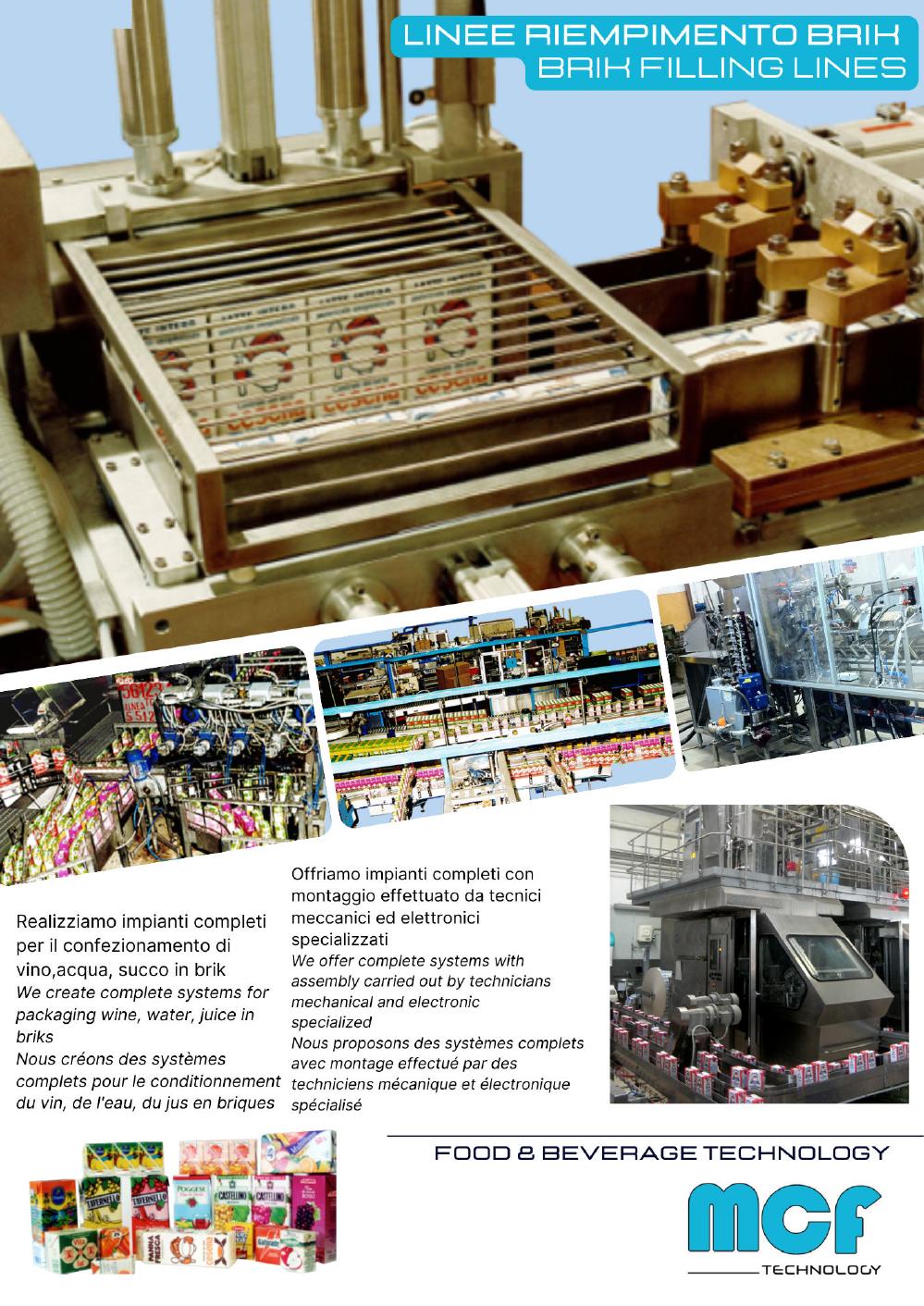
Aseptic carton brick filling line
Brick carton plant: packaging material sterilising, forming, aseptic filling of milk, juices and beverages, straw applying and case packing.
Finished products: Vino, Acqua, Succo.
Full sheet and technical dataHow to install and operate the brik aseptic filling line — wine, water, juice: step-by-step procedure (about 36 working days)
The operating sequence MCF Technology follows to install, commission and start up the brik aseptic filling line — wine, water, juice, through to daily operation and planned maintenance. Delivery, erection and on-site service are included worldwide.
- 1. Site survey and utilities check (2 days): Technical survey on the layout of the brik aseptic filling line — wine, water, juice: passage heights, flooring and drains, maintenance clearances and availability of filtered compressed air, steam or peroxide for packaging-material sterilisation and cooling water. The final list of customer-side preparations is handed over.
- 2. Shipment, receiving and positioning of the modules (3 days): Worldwide delivery with sea-freight or road packing, unloading and positioning of the modules (Sterilizzatore UHT con omogeneizzatore asettico, Serbatoio asettico di sosta, Riempitrice brik asettica con applicatore tappo) on the areas foreseen by the layout, checking the packing list and the condition of the components.
- 3. Mechanical assembly and piping (15 days): Assembly of the units, conveyor alignment, hygienic welding of the stainless-steel piping and installation of valves and instruments according to the P&ID, supervised on site by MCF Technology technicians.
- 4. Utility hook-ups and electrical connections (4 days): Connection of filtered compressed air, steam or peroxide for packaging-material sterilisation and cooling water, wiring of the electrical cabinet and PLC, earthing, HMI configuration and process recipes for the planned formats (Vino, Acqua, Succo).
- 5. Sanitation, CIP and dry runs (3 days): Washing and passivation of the product-contact surfaces, CIP circuit verification with flow, temperature and detergent-concentration control, tightness tests and dry-run cycles on all modules.
- 6. Functional commissioning and process trials (4 days): validation of packaging-material sterilisation, carton forming and sealing test, tightness and volume check. Trials are run with the customer's real product and recorded in the commissioning report.
- 7. Production start-up and staff training (5 days): Assisted start-up with continuous production, training of operators and maintenance staff on HMI, format changeover, safety and sanitation, handover of manuals and drawings in the agreed language.
- 8. Daily operation and planned maintenance: Daily operation with longitudinal and transversal seals, dosed volume, sterility of the filling chamber. Planned maintenance: replacement of sealing bars and mandrels, dosing-nozzle and splice-sensor checks. On-site and remote service with critical spare parts agreed in the quotation.
Durations and activities are indicative: the erection, commissioning and training plan is defined in the quotation after the site survey and line sizing. No figure is a contractual performance.
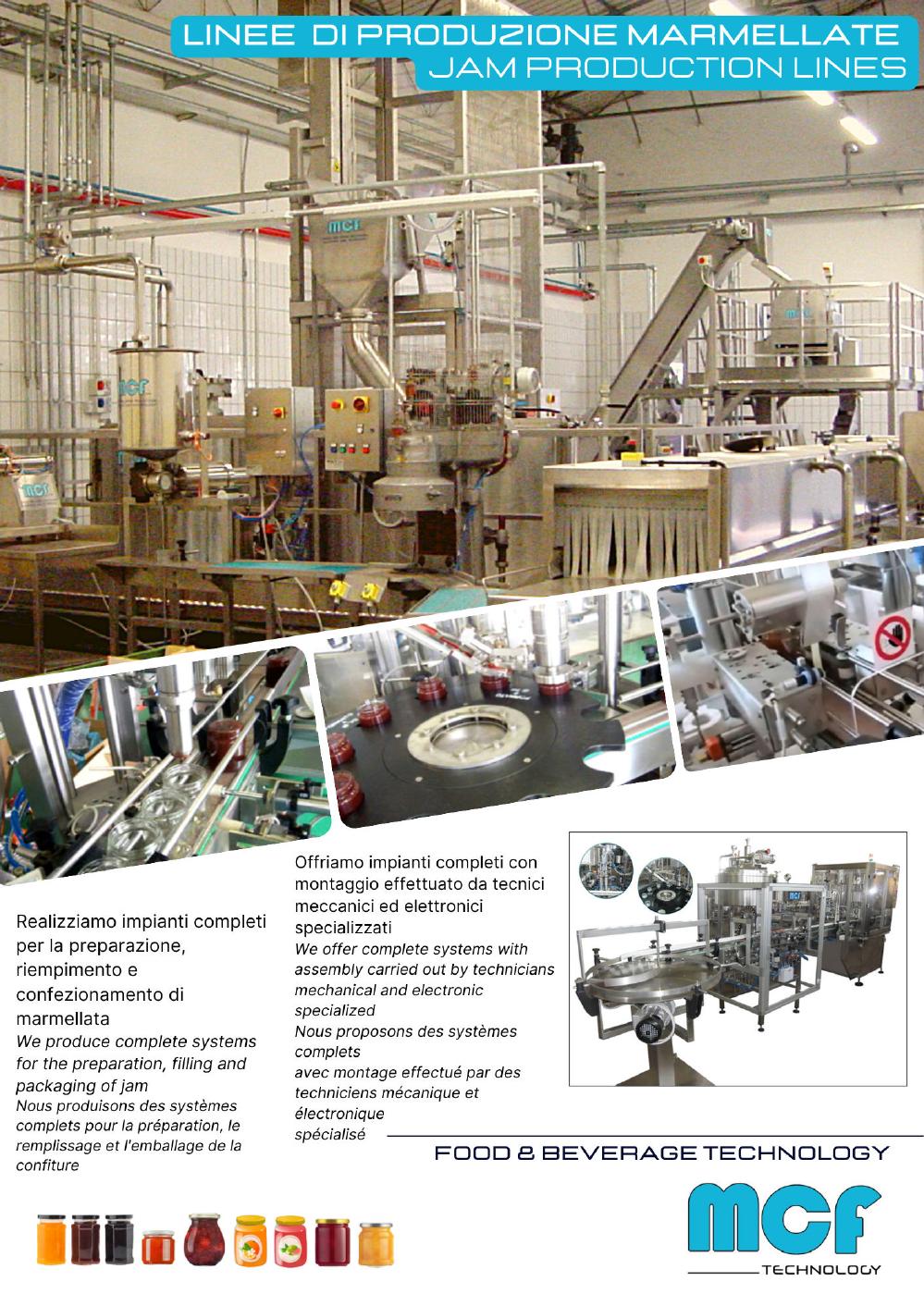
Jam and preserves production line
Plant for jams, marmalades and compotes: fruit preparation, vacuum cooking, hot jar dosing, capping, pasteurising and labelling.
Full sheet and technical dataHow to install and operate the jam production line — turnkey preserves plant: step-by-step procedure (about 33 working days)
The operating sequence MCF Technology follows to install, commission and start up the jam production line — turnkey preserves plant, through to daily operation and planned maintenance. Delivery, erection and on-site service are included worldwide.
- 1. Site survey and utilities check (2 days): Technical survey on the layout of the jam production line — turnkey preserves plant: passage heights, flooring and drains, maintenance clearances and availability of steam for vacuum cooking, cooling water and food-grade compressed air. The final list of customer-side preparations is handed over.
- 2. Shipment, receiving and positioning of the modules (3 days): Worldwide delivery with sea-freight or road packing, unloading and positioning of the modules (Preparazione frutta e dosaggio zuccheri/pectine, Cuocitore sotto vuoto e rifrattometro in linea, Pastorizzatore/scambiatore e serbatoi tampone) on the areas foreseen by the layout, checking the packing list and the condition of the components.
- 3. Mechanical assembly and piping (12 days): Assembly of the units, conveyor alignment, hygienic welding of the stainless-steel piping and installation of valves and instruments according to the P&ID, supervised on site by MCF Technology technicians.
- 4. Utility hook-ups and electrical connections (4 days): Connection of steam for vacuum cooking, cooling water and food-grade compressed air, wiring of the electrical cabinet and PLC, earthing, HMI configuration and process recipes.
- 5. Sanitation, CIP and dry runs (3 days): Washing and passivation of the product-contact surfaces, CIP circuit verification with flow, temperature and detergent-concentration control, tightness tests and dry-run cycles on all modules.
- 6. Functional commissioning and process trials (4 days): cooking trial with Brix and vacuum curve, pectin dosing check and hot filling with capping. Trials are run with the customer's real product and recorded in the commissioning report.
- 7. Production start-up and staff training (5 days): Assisted start-up with continuous production, training of operators and maintenance staff on HMI, format changeover, safety and sanitation, handover of manuals and drawings in the agreed language.
- 8. Daily operation and planned maintenance: Daily operation with Brix and pH, filling temperature, jar vacuum and cap integrity. Planned maintenance: agitator and vacuum-pan seal checks, filler cleaning and probe calibration. On-site and remote service with critical spare parts agreed in the quotation.
Durations and activities are indicative: the erection, commissioning and training plan is defined in the quotation after the site survey and line sizing. No figure is a contractual performance.
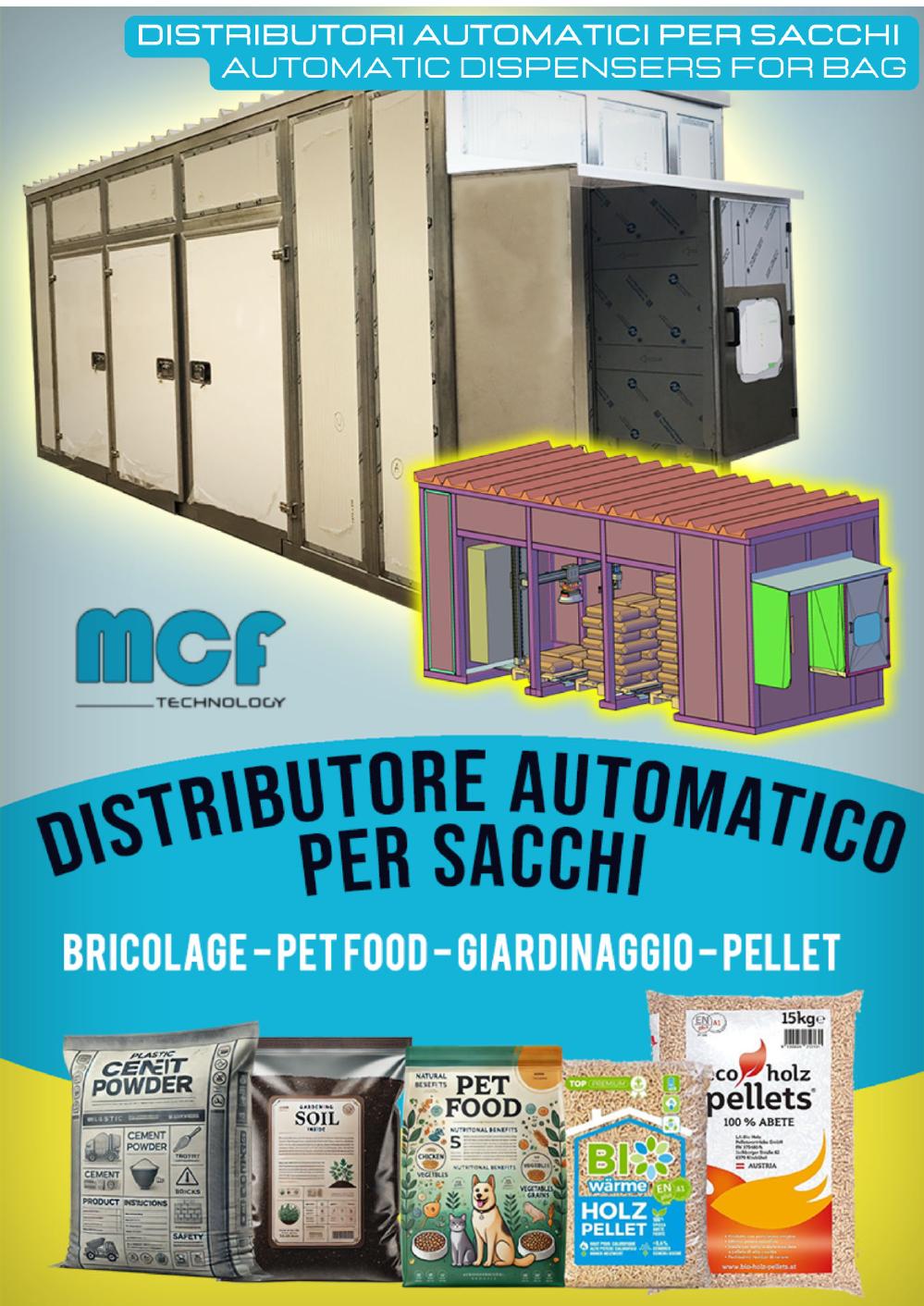
Automatic bag dosing and bagging systems
Solutions for bulk and granular products: weighing, dosing, bag filling and closing, automatic dispensers and end-of-line palletising.
Finished products: Bricolage, Pet food, Giardinaggio, Pellet.
Full sheet and technical dataHow to install and operate the automatic bag dispensers — diy, pet food, pellet: step-by-step procedure (about 29 working days)
The operating sequence MCF Technology follows to install, commission and start up the automatic bag dispensers — diy, pet food, pellet, through to daily operation and planned maintenance. Delivery, erection and on-site service are included worldwide.
- 1. Site survey and utilities check (2 days): Technical survey on the layout of the automatic bag dispensers — diy, pet food, pellet: passage heights, flooring and drains, maintenance clearances and availability of compressed air, power supply for the handling units and a pallet storage area. The final list of customer-side preparations is handed over.
- 2. Shipment, receiving and positioning of the modules (3 days): Worldwide delivery with sea-freight or road packing, unloading and positioning of the modules (Silos, tramogge e trasporto prodotto, Stazione di pesatura e insacco, Cucitrice/saldatrice e metal detector) on the areas foreseen by the layout, checking the packing list and the condition of the components.
- 3. Mechanical assembly and piping (8 days): Assembly of the units, conveyor alignment, hygienic welding of the stainless-steel piping and installation of valves and instruments according to the P&ID, supervised on site by MCF Technology technicians.
- 4. Utility hook-ups and electrical connections (4 days): Connection of compressed air, power supply for the handling units and a pallet storage area, wiring of the electrical cabinet and PLC, earthing, HMI configuration and process recipes for the planned formats (Bricolage, Pet food, Giardinaggio).
- 5. Sanitation, CIP and dry runs (3 days): Washing and passivation of the product-contact surfaces, CIP circuit verification with flow, temperature and detergent-concentration control, tightness tests and dry-run cycles on all modules.
- 6. Functional commissioning and process trials (4 days): bag opening and presentation test, weight-dosing calibration, closing and palletising trial. Trials are run with the customer's real product and recorded in the commissioning report.
- 7. Production start-up and staff training (5 days): Assisted start-up with continuous production, training of operators and maintenance staff on HMI, format changeover, safety and sanitation, handover of manuals and drawings in the agreed language.
- 8. Daily operation and planned maintenance: Daily operation with bag net weight, closure integrity and palletising consistency. Planned maintenance: gripper and suction-cup checks, load-cell calibration and conveyor belt inspection. On-site and remote service with critical spare parts agreed in the quotation.
Durations and activities are indicative: the erection, commissioning and training plan is defined in the quotation after the site survey and line sizing. No figure is a contractual performance.
Industrial high pressure homogenizers
Homogenizers for milk, juices, creams and emulsions: particle size reduction, product stability and integration into existing processing lines.
Finished products: Latte UHT, Bevande vegetali, Succhi, Creme, Salse.
Full sheet and technical dataHow to install and operate the industrial homogenizer — high-pressure food & dairy: step-by-step procedure (about 27 working days)
The operating sequence MCF Technology follows to install, commission and start up the industrial homogenizer — high-pressure food & dairy, through to daily operation and planned maintenance. Delivery, erection and on-site service are included worldwide.
- 1. Site survey and utilities check (2 days): Technical survey on the layout of the industrial homogenizer — high-pressure food & dairy: passage heights, flooring and drains, maintenance clearances and availability of cooling water for the heads, a dedicated power supply and already deaerated incoming product. The final list of customer-side preparations is handed over.
- 2. Shipment, receiving and positioning of the modules (3 days): Worldwide delivery with sea-freight or road packing, unloading and positioning of the modules (Corpo pompa a pistoni con riduttore, Gruppo valvole di omogeneizzazione a due stadi, Circuito di raffreddamento e lubrificazione) on the areas foreseen by the layout, checking the packing list and the condition of the components.
- 3. Mechanical assembly and piping (6 days): Assembly of the units, conveyor alignment, hygienic welding of the stainless-steel piping and installation of valves and instruments according to the P&ID, supervised on site by MCF Technology technicians.
- 4. Utility hook-ups and electrical connections (4 days): Connection of cooling water for the heads, a dedicated power supply and already deaerated incoming product, wiring of the electrical cabinet and PLC, earthing, HMI configuration and process recipes for the planned formats (Latte UHT, Bevande vegetali, Succhi).
- 5. Sanitation, CIP and dry runs (3 days): Washing and passivation of the product-contact surfaces, CIP circuit verification with flow, temperature and detergent-concentration control, tightness tests and dry-run cycles on all modules.
- 6. Functional commissioning and process trials (4 days): pressure test with water and with product, particle-size check after homogenisation and outlet temperature control. Trials are run with the customer's real product and recorded in the commissioning report.
- 7. Production start-up and staff training (5 days): Assisted start-up with continuous production, training of operators and maintenance staff on HMI, format changeover, safety and sanitation, handover of manuals and drawings in the agreed language.
- 8. Daily operation and planned maintenance: Daily operation with working pressure, product temperature and absence of leaks from the seals. Planned maintenance: replacement of seals and homogenising valves, oil check and pressure-gauge calibration. On-site and remote service with critical spare parts agreed in the quotation.
Durations and activities are indicative: the erection, commissioning and training plan is defined in the quotation after the site survey and line sizing. No figure is a contractual performance.
Price on request. Quotation, layout and feasibility study via contact. Full English overview: processing lines. Italian light catalogue: versione leggera.